Stencil Patterns – The Difference Between Single and Multiple Layer Stencils!
When discussing stencil patterns, you need to be familiar with the differences between a single and a multiple layer stencil.
Single Layer (Silhouette) Stencils are complete with only one stencil. I call these Silhouette Stencils because they create an image that appears to be a shadow or silhouette of an object. They do not offer much opportunity to use more than one color.
Multiple Layer (Overlay) Stencils consist of more than one stencil (called overlays) and they leave you with a more complete image than a Single Layer Stencil. If you are really trying to get that hand painted look, a Multi-Layer Stencil is a must. They are more work of course but the results are well worth it.
Multiple Overlay Stencil vs. Single Layer Stencil Patterns
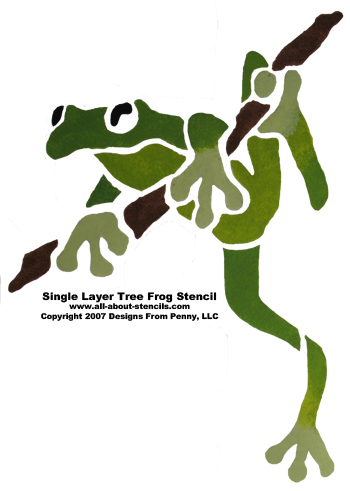
A single overlay stencil is a complete design on a single sheet. It will have gaps or bridges between the individual elements of the design which emphasize the details of the image. The frog below is from a single layer stencil. Even though he has several different colors his details are not well defined. Notice the spaces between the elements of his form.
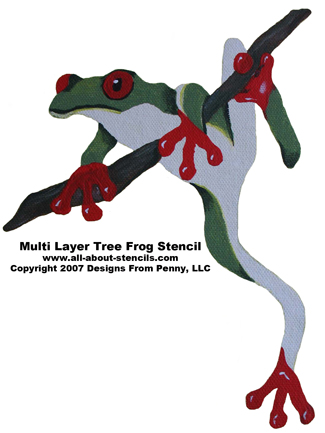
Multiple overlay stencils use two or more sheets to define more detail of a design. The completed image will not have any gaps. The frog below has 5 overlays. Each overlay is for a different color. This frog’s details are well defined.
Aligning Multiple Overlay Stencils
Multiple Overlay Stencils are designed with registration holes which are used to mark your stenciling surface. This allows the correct positioning of each overlay with respect to the previously stenciled area. Registration holes (marks) may be in the form of triangles or circles.
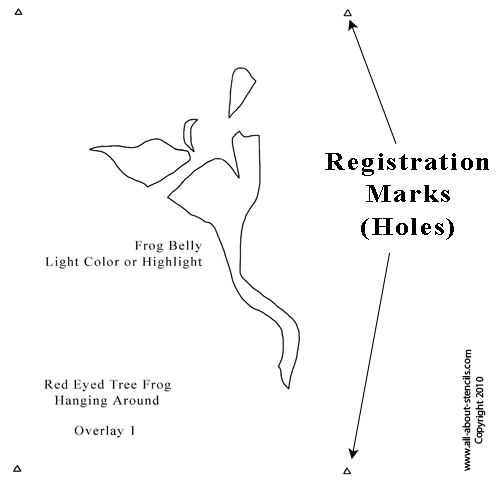
Each stencil overlay will be numbered. Align your first overlay as you would a single overlay stencil in the area to be painted. Tape all the edges. Use a pencil to mark the registration holes (they can be erased or painted over when your project is finished). Hint: To avoid marking the surface, place pieces of low-tack tape on the surface area of the registration holes and place the marks on the tape.
After applying the paint, carefully remove overlay #1. Do any touching up that needs to be done. Allow the paint to dry.
When the paint of overlay #1 is thoroughly dry, put overlay #2 in place and line up with the registration holes. When the overlay is lined up, tape and apply paint.
Continue in this same manner with each overlay until you have a completed picture.
Don’t forget to eliminate the registration marks.
Well, that's about it in a nutshell. Hopefully this page has helped you become aware of the different stencil patterns available so you can make the best choices for your art projects.
In an effort to bring you a complete solution for all of your stenciling needs, we now have a catalog for you to browse a large variety of designs that you can open at your computer and print now or save. Just check out our Printable Stencils for your next project.
Below is a sample of the design books that we offer. This book includes the stencils used as examples on this page. Each book will come to you as a downloadable pdf file in your e-mail. Just check your e-mail after purchase for the link to connect to your file and print or save. It's that easy!
All designs can be adjusted to fit your project size. Instructions are included. Pages are 8.5” x 11”.
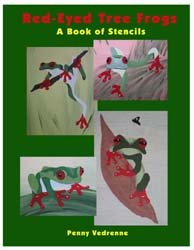
Red-Eyed Tree Frogs Book
Bring a little of the rain forest to your home.
Four Tree Frog Stencil Designs -
Each book will come to you as a downloadable pdf with 37 8.5"x11" pages. All designs can be adjusted to fit your project size. Instructions are included. Check your e-mail after purchase for the link to connect to your file and print or save. It's that easy!
Price: $9.95

To get this book in print for just $19.95 click here:

 |
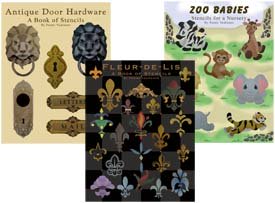
If you’d rather get your Stencil Pattern Books in Print (like these or the Tree Frogs from above), then visit our Printer’s Book Shop for a large variety of stencil collections. You’ll find all of the stencil patterns used as examples throughout this site.
Well, that's all for now.
Happy Stenciling,
Penny
Here's a video about Stenciling Wall Borders that I think you might find interesting. Enjoy!
Would you like to build a web site like this one and turn a passion into a business? Well, if I did it, you can too. Don't think that you have to be a web designer and know all about computer codes and complicated html stuff. I didn't. With Solo Build It! it's easy and they have the tools in place to help you build pages and teach you how to create a successful web site. Want more information? Just click on Powered by Solo Build It! and watch a cool video that will explain everything. I know you'll get excited like I did.
Return to Home Page from Stencil Patterns!



You'll be amazed at how many Free Stencils we have to offer to you! Just to make it easy, here are the links to all the freebies.
By the way, if you are looking for Free Christmas Stencils or Free Halloween Stencils, there were too many to list here so go to
Holiday Crafts!
Airbrush Stencils
Angel Stencil
Animal Stencils
Art Deco Stencil
Art Nouveau Stencil
Butterfly Stencils
Cat Stencils
Celtic Stencils
Cool Stencils
Cross Stencil
Dinosaur Stencil
Dog Stencil
Dolphin Stencil
Eagle Stencil
Flower Stencils
Graffiti Art Stencils
Grapevine Stencil
Guitar Stencil
Heart Stencil
Letter Stencils
Palm Tree Wall Stencils
Pineapple Stencil
Free Printable Stencils
Paisley Stencil
Quilting Stencil Patterns
Rose Stencil
Skull and Crossbones Stencil
Southwestern Stencils
Sports Stencils
Stencils Quilting
Teddy Bear Stencil
Toile Stencils
Tree Stencils
Tribal Stencil
Trompe l oeil
Tropical Flower Stencil
Valentine Stencils
I hope you truly enjoy these Free Stencils! Thank you so much for visiting and coming back soon for more Stenciling Ideas!
For art supplies, books and much more please visit our Affiliates below.
Save up to 75% on Art Supplies!
MisterArt.com has a dedicated department for stencil supplies. Here you'll find stencil films, paints, books and tools plus and extensive selection of applicators including brushes and sponges.
In these times, we're always looking for a bargain. CreateForLess has a good selection of plastic pallets for you to choose. Plus you'll find Delta Ceramacoat and DecoArt Paints, stencil brushes and applicators, a few pre-cut stencil designs, and many other items on your stencil supplies checklist.
Joann.com carries a variety of high quality acrylic paints, great for stenciling. You'll find brands like Delta Ceramacoat, Folk Art, Americana and DecoArt. They also provide paint applicators and many other arts and crafts and stencil supplies.

If it's pre-cut stencil designs that you are looking for, then I may suggest Stencil Ease . They have decorative, alphabet and industrial designs or they can custom make one for you. You'll also find Americana Acrylic Paints and other stencil supplies.
New! Comments
Please share your ideas and any variations to this project you have!