How To Garment Stenciling
You are unique! So your clothes should reflect your own creative style. Learn how to garment stenciling for a unique wardrobe that’s all about you.
The ways to embellish clothing using a little paint and stencils is only limited by your imagination. And I know there is no limit there. This project is going to step you through painting a Chinese Dragon on the front of a pair of jeans (purchased at a 2nd hand shop by the way) and a Chinese Symbol for Dragon on the back pocket.

Since this section is specifically about how to garment stenciling, I will assume that you know how to do basic stenciling. But, don’t worry if you don’t. Just click here to get instructions on How To Stencil and then come back here to how to garment stenciling and build on that knowledge. This whole site is dedicated to stenciling and crafts, so whatever you need to know, it’s here.
Also, we'll be stenciling with fabric paint and a brush so if you are looking for information on Air Brushed Stenciling there are a few great videos for you to watch and don't miss the free Stencils for Airbrushing Patterns.
Don't miss the video at the bottom of the page to see a t-shirt, a pair of jean and a denim jacket decorated with an eagle stencil.
What you will need:
Of course, you will need something to put paint on like a pair of jeans. But again, use your imagination and let the creative juices flow. You may have a jean jacket in your closet that you want to spruce up a bit. Remember that this is all about how to garment stenciling so find something made of fabric. Great! Anyway, you get the picture!
If you are working with a newly store bought garment, make sure it does not have a stain resistant finish. I recommend that you pre-wash your fabric, so that you’ll be sure it’s clean of any surface treatment that will keep the paint from adhering. But don’t use a fabric softener.
Since this example is all about how to garment stenciling, you will need textile paints, specifically designed to be both washable and dry cleanable. These paints require 24 hours to dry and may need to be heat set. Nontoxic water-based textile paints are commonly available at craft stores. Make sure you read all the directions on the paints you choose. Each brand has different requirements and you want to be well aware of the procedures you need to follow before you start painting.
Here are a couple of suggestions of where to find fabric paints and crafts supplies.
MisterArt.com has a large variety of fabric paints. You'll find paints that dry with special effects like a wet or puffy look and some with reflective, sparkling flakes for a 3-D effect. Plus they have DecoArt Fabric Medium, when mixed with Crafter's Acrylics, produces a washable, permanent paint for fabrics. You will also find a few pre-cut stencil designs.
In these times, we're always looking for a bargain. CreateForLess carries the DecoArt SoSoft Fabric Paints at great prices! They also have some items for you to decorate like aprons and a chef hat. They are a supplier of all your crafting needs and a good source for your how to garment stenciling project.
Joann.com is another supplier of all your arts and crafts need that carries a nice variety of fabric paints.
Also, you'll need to have something to put under the fabric to hold it from moving or sliding around and also to keep paint from seeping through to the other side. A piece of cardboard will work fine. If you are working on the leg of jeans just slide the cardboard inside. You want to have a piece that fits well enough to keep the fabric in shape but not to the point it will stretch the fabric.
Of course, you will need all the other usual stenciling stuff: paint applicators (brushes or foam), stencils, tape…
Here are some quick reminders on Basic Stenciling:
Do not add water or thin the paint. Watery paint will bleed under your stencil edges. If you want to lighten a color, add white. I generally do not recommend blending colors because if you need to touch up or reproduce that color later it is close to impossible. However, the selection of fabric paints is more limited than the vast array of acrylic paints, so you may need to blend paints to get the color you desire.
Test the colors and practice your painting on a scrap piece of fabric similar to the one you are stenciling. Maybe you can test in a hem or where the paint won’t be seen.
Make sure your brush is evenly covered with paint but do not over load it. An over loaded brush will spread paint under the edges of the stencil. Your goal is a nice, even dry brush technique with color that is smooth but not thick. You are looking to achieve crisp, clear edges.
Apply the paint with a gentle pouncing motion, holding the brush straight up and down. This will keep the paint from seeping under the edges of the stencil. Do not brush side to side or use a stroking motion.
Paint all the colors in your design before removing the stencil. Once it has been removed, it is almost impossible to replace it in exactly in the same spot. When you are finished, lift the stencil carefully.
Tips and Hints for Stenciling on Fabric:
Since this article is about how to garment stenciling, we need to discuss specific information about applying paint to fabrics.
If you can, purchase an extra piece of fabric for practice. Having some experience is invaluable.
After you remove the stencil, you can use an artist’s brush to touch up areas where the paint may be too thin or missing along an edge. Remember brushed on paint looks different from paint applied with normal stenciling techniques so use this for only minor problems.
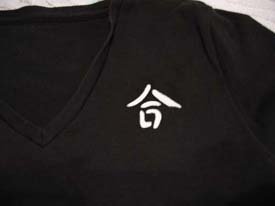
Just a quick side note: When you finish these instructions, try this Spray Paint T-Shirt Project . I'll show you how to spray paint this Harmony Symbol onto a black T-Shirt.
If paint gets on the fabric where it is not supposed to be, wash it out immediately and dry it with a hair dryer.
In fact, if your stencil is a disaster, you can usually wash the whole stencil out and start again as long as you do so immediately. Again, read the directions on the bottle.
Sometimes, dried paint can be very carefully scraped off with a matte knife. Just make sure it is thoroughly dried or it will smudge.
Always read the instructions on the paint that you are using. Some of them require you to “fix” the paint with heat by ironing. You also want to be aware of the washing instructions. Some paints are effected by dry cleaning, machine washing or detergents. They may require hand washing. Read the instructions and make sure you are satisfied with the requirements before you purchase the paint.
If you can’t find fabric paints, acrylics work just fine on fabrics too! They don’t even require heat setting like most fabric paints. However, since they were not made for fabric, there is no telling how they will react to washing. I recommend testing on scrap fabric similar to your project piece. You may want to start off with hand washing using a mild soap. Also, acrylic paints dry stiffer than fabric paints so it is not your best choice on a T-Shirt (better for jeans).
Experiment, Practice, Enjoy!
How-To Garment Stenciling: Creating a Unique Look
First make sure that the garment is clean and get all of your supplies ready.
Put a sturdy piece of cardboard or other material inside or behind the garment. I like to give the fabric one quick but thorough pass with a lint roller to remove any loose debris such as hair, dust or lint. Line up your stencil where you would like your image to appear. Tape the stencil down at all four corners and along each side. If you are working on a Multiple Overlay Stencil (like the one in the example), don’t forget that you need to mark your registration holes so that you can line up the next overlay. I like to put some masking tape behind the holes and mark on those instead of marking on the garment.
If you don’t know what I’m talking about and need more information on a Multiple Overlay Stencil , don’t worry. Just click on the link and you will get all the details. Then come back here to continue with your how to garment stenciling project. This article is all about how to garment stenciling by applying paint with a stencil brush. If you are interested in using spray paint stencils, just click on this link. You’ll be taken to a page where I put a Chinese Harmony Symbol on a Black T Shirt.
Pour paint onto your palette and apply to open areas using the pouncing motion (stippling technique). Start around the edges of the stencil openings (islands) and work your way in. I can’t say it enough – make sure that your brush is on the dry side so that you won’t get paint seeping under the stencil and blurring your finished image. This is especially important when working with fabric. Notice on the picture below that I even used the stencil as a last chance blotter to get the brush as dry as possible. This layer took several coats of paint.
For this how to garment stenciling project, I’m using a bright green paint along the top of the dragons body and an orange along his belly. This is what the first stencil overlay looks like when finished.
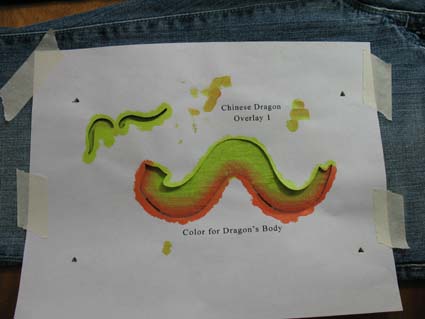
Wait until the paint dries and carefully peel off the stencil.
Let’s assume that the instructions above were referring to your first overlay of a Multiple Overlay Stencil. Before you remove the stencil, did you mark your registration holes so that you can line up your next overlay? If not, do it now. OK – the paint is dry, you have removed the first overlay and did any touching up that had to be done.
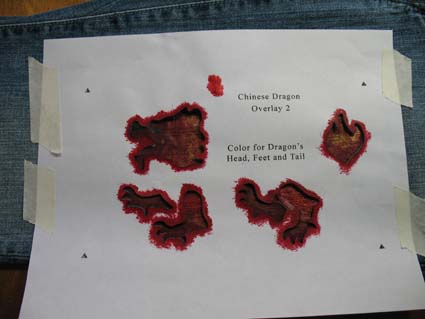
When all the paint for overlay #1 is thoroughly dry, put overlay #2 in place and line up with the registration marks. When the overlay is lined up, tape and apply paint.
Continue in this same manner with each overlay until you have a completed picture. For our example, here is overlay 3 – the last overlay. It is for the Dragon’s eye and nose. The other spots are where I blotted a little extra paint from the brush.
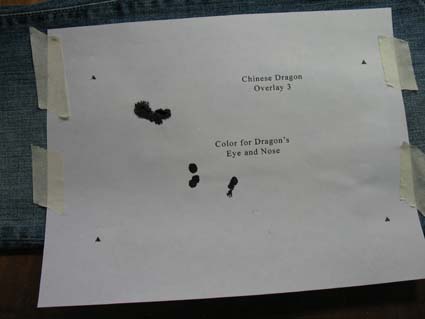
Wait until the paint dries and carefully peel off the stencil. Don’t forget to eliminate the registration marks.
But wait we aren’t done yet. Just to finish off the project with a unique touch, we are going to put a Chinese Symbol for Dragon on the back pocket of the jeans to complete the theme and give you a little more practice for your how to garment stenciling project.
This is just a single layer stencil so no need to fuss with registration marks. Just line up the stencil where you want it, tape it down and apply paint. Of course, wait for the paint to dry thoroughly and remove the stencil.
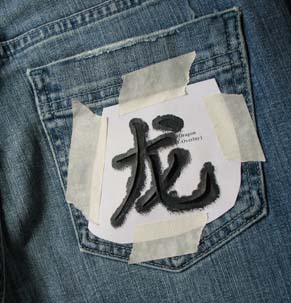
Voila! You have a beautiful pair of custom jeans!
Well, I hope you learned how to garment stenciling and I really hope you enjoyed following the Dragon Jeans Project. Try it out for yourself and have some fun(you can get the stencils below). So, go on, get started stenciling!
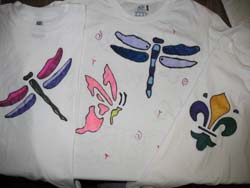
Want more "How To Garment Stenciling" ideas? Well, I created a new tradition with a t-shirt decorating event during a Football Tailgating Party. I designed it for the kids but some of the adults got involved. It was great! They can do football or mascot themes or just any old image (we used the free stencils). And best of all we did this with fabric markers and regular Sharpies so it wasn't as messy as paints. Just watch this video about how to create your own t-shirt decorating event (just click on the text or the picture).
Also, in an effort to bring to you a complete solution for all of your stenciling needs, we now have a catalog for you to browse a large variety of designs. So, check out our Stencils Catalog for your next project.
Below is a sample of the design books that we offer. These are the stencils used as examples on this page. Each book will come to you as a down-loadable pdf file in your e-mail. Just check your e-mail after purchase for the link to connect to your file and print or save. It's that easy!
All designs can be adjusted to fit your project size. Instructions are included. Pages are 8.5” x 11”.
If you'd rather get your Stencil Books in Print, just click the blue button below each book.
 |


Oriental Designs: A Book of Stencils
This collection includes 16 designs- Chinese Dragon, Bamboo, Oriental Figure with Coolie Hat, Ying Yang Koi, Bonsai Tree and 3 Cranes plus 10 Chinese Symbols (Eternity, Friendship, Happiness, Harmony, Long Life, Peace, Prosperity, Tranquility, Truth and Dragon.
This purchase is of a PDF file with 40 pages.
Price: $9.95

To get this Book in Print for just $19.95 click here:

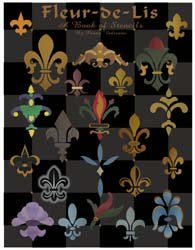
Fleur de lis: Book of Stencils
This collection includes 22 designs. Ten are easy single overlay. Six have 2 overlays and six have 3 overlays. Click on the book to get more information on How To Garment Stenciling and a t-shirt project.
This purchase is of a PDF file which has 63 pages.
Price: $9.95
To get this Book in Print for just $19.95 click here:

Red-Eyed Tree Frogs
This book contains 4 cute Red-Eyed Tree Frogs for you to paint in your next project. Bring a little of the rain forest to your home. There are 37 pages in this pdf file which includes the stencils of all 4 frogs (each has 5 overlays) and complete instructions.
This purchase is of a PDF file with 36 pages.
Price: $9.95
To get this Book in Print for just $19.95 click here:

For this how to garment stenciling article the Chinese Dragon and Symbol Stencils are courtesy of
Designs From Penny.
Still looking for more information on how to garment stenciling? Well, if it's books that you want, then check out some of the suggestions from Amazon.com

on the subject of how to garment stenciling. I've also added a couple of arts and crafts shops that I go to for supplies. And if you still need help with how to garment stenciling, there is a Google Search Tool for your convenience.
Would you like to build a web site like this one and turn a passion into a business? Well, if I did it, you can too. Don't think that you have to be a web designer and know all about computer codes and complicated html stuff. I didn't. With Solo Build It! it's easy and they have the tools in place to help you build pages and teach you how to create a successful web site. Want more information? Just click on Powered by Solo Build It! and watch a cool video that will explain everything. I know you'll get excited like I did.
Wait! Don't go yet. Here's that video I promised you. Find the pattern for free at Eagle Stencil. Enjoy!
Return to Home Page from How To Garment Stenciling.
Return to Decorating With Stencils from How To Garment Stenciling.



Learning anything is so much easier when you can watch it being done in live motion. So, don't miss the very informative Art Videos that will step you through the many processes of using stencils to create art.
If it's Free Stencils you are looking for you'll find more than you can imagine here. It's my mission to get you motivated to creating art with stencils so I've created all the most popular stencil designs but some rare designs too (like Toile Stencils ) and they're all Free!
For art supplies, books and much more please visit our affiliates below.
Save up to 75% on Art Supplies! MisterArt.com has a dedicated department for stencil supplies. Here you'll find stencil films, paints, books and tools plus and extensive selection of applicators including brushes and sponges. In these times, we're always looking for a bargain. CreateForLess has a good selection of plastic palettes for you to choose. Plus you'll find Delta Ceramacoat and DecoArt Paints, stencil brushes and applicators, a few pre-cut stencil designs, and many other items on your stencil supplies checklist. Joann.com carries a variety of high quality acrylic paints, great for stenciling. You'll find brands like Delta Ceramacoat, Folk Art, Americana and DecoArt. They also provide paint applicators and many other arts and crafts and stencil supplies.

If it's pre-cut stencil designs that you are looking for, then may I suggest Stencil Ease. They have decorative, alphabet and industrial designs or they can custom make one for you. You'll also find Americana Acrylic Paints and other stencil supplies.
New! Comments
Please share your ideas and any variations to this project you have!